 timmyrawlins
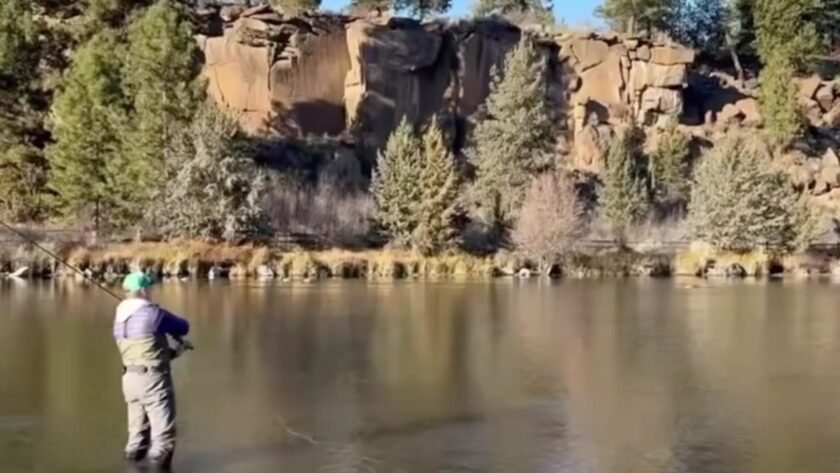
Saturday's lesson was one of those good ones. The student was a very savvy guy with a strong single-hand casting background, but he didn't know much about Spey — not the terms, not the names of the casts, not the details of Spey casting in general. He did know one cast: the Snap T, cack-handed off the up wind shoulder. That was about it.
But he was an extremely sharp cookie. He could do the movements I asked him to do, and he had a high level of understanding when it came to following direction — which is hard for so many casters. That alone makes a lesson a pleasure.
One of the first things I do with a new Spey caster is introduce the Double Spey. We're on river right, and a downstream wind makes us want to cast off the downwind shoulder — so we don't get whacked, of course. That's often the case with the lessons I do here.
The Double Spey has a few things that matter more than anything else.
Number one: make sure all of the slack is out of the line before you even attempt to set the anchor. All of it. If there's slack in the line, the cast is compromised before it starts.
Number two: once the anchor is set, rest the rod on the upstream shoulder. The first movement of the rod tip goes out toward the opposite bank and around — as if you're drawing a sombrero brim with the rod tip.
Here's the analogy I use: we are a martini glass. Our body is the stem. So we keep the rod close to our body — hands close together — and we draw that sombrero brim, or in this case the rim of the martini glass, with the rod tip. A big half circle. Our D-loop actually starts forming at the very beginning of the cast, and the bottom of the D-loop has to pirouette around. The caster has to be patient and allow the D-loop to swing around and line up before throwing the cast.
My student wanted to be premature with his cast. He used his arms a little too wide at first, trying to imitate the act of being a martini stem. But when he kept his hands close together — sometimes even pinning his right elbow in close — and was patient for the D-loop to come around, he threw some extremely nice casts. And since he wasn't trying for distance, he was getting distance with very little effort.
It was very satisfying for both of us.
His breakthrough came when he didn't rush the cast, but was patient. When he slowed himself down — spirit, soul, and body — and moved the rod tip around in a relaxed fashion, being patient for the D-loop to come around behind him a little more (but not directly behind him), his cast would go off effortlessly. As long as he remembered one thing: the rod tip must sweep up, and not be allowed to drop down with a sloppy wrist. That's one thing I have to constantly be aware of in my own casting.
He was somewhat of a perfectionist, and he had some very high-level questions — the kind that will only be answered after he has a lot of reps under his belt. I could only answer them in terms of an intermediate or higher-level caster, and he wasn't ready for that yet. So we just went on to the next rep.
I'm extremely adamant about looking forward to the next cast and not getting bogged down with the mistakes we just made. I'm more about what's pertinent to do on the next cast — getting that good-repetition groove in the brain a little more. It's like how they train bank personnel to recognize counterfeit cash: they teach them to be so familiar with real cash that phony bills are easy to discern. I want my casters to build on doing something good, or better, and expand on that — without getting bogged down in mistakes as opposed to success.
And I resorted to one of my favorite tricks for showing anybody how to cast better: I took a video of him making a few casts and showed it to him, so he could see that I'm really not lying, and his body is in stark disobedience to what his mind is telling him it is doing. The camera doesn't lie.
He left a better caster than he arrived. That's the whole job.


