 timmyrawlins
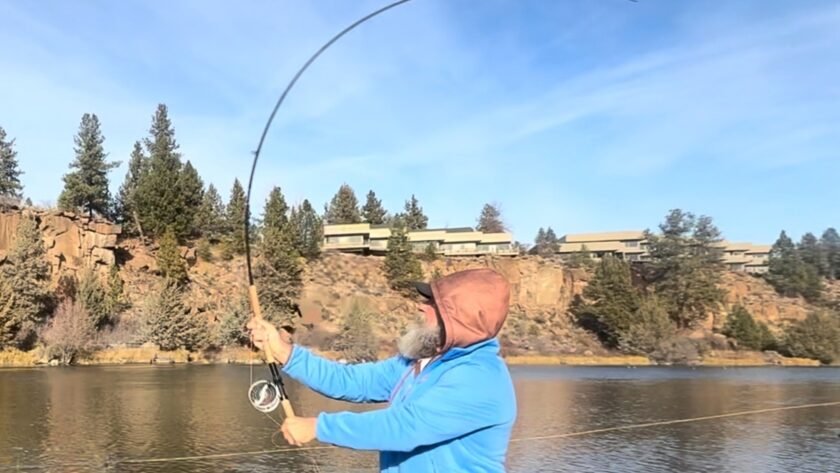
A student of mine sent me a video the other day. He was out on the Rhine in the fog, the water high, working on his cast. He asked me to take a look and tell him what I saw.
Here’s what I told him — and it’s the same thing I’d tell any caster standing where he’s standing.
First, the good news
My first thought when I saw the first cast was: man, you look confident, and in control. I love that. That matters more than people think. A caster who looks comfortable is a caster who’s stopped fighting the rod, and that’s a big step. Compared to your first videos, this is night and day. Kudos — the work is showing.
But you’re at that interesting stage now. You’re past beginner. I’d call you a solid intermediate. And the jump from intermediate to advanced intermediate isn’t about learning new casts. It’s about making every cast the same cast.
Right now, your casting is a little inconsistent — every time, it’s a little bit different. That’s the thing to fix. Not with more power. With more sameness.
Slow down the lift
I’d like to see every lift slowed down. Very smooth and slow, every single one. The lift sets up everything that follows — rush it and the whole cast is built on a shaky start. Slow it down and the line comes up clean, the rod loads the way it should, and the rest of the cast gets easy.
And while you’re lifting, be present. Think about exactly what you’re doing — not the next step. One piece at a time. The cast will wait for you.
Same sweep, every time
Let’s go back to half a dozen strips. Shorter running line to shoot, less to manage. And I want to see every sweep the same — same smoothness, same rod tip path. If your sweep changes every cast, your anchor changes every cast, and your forward cast never has a chance to be consistent. Same sweep, same anchor, same cast. That’s the whole game at this stage.
Watch the anchor land
Here’s the other reason I want you to forget about distance for now: I want you to watch your anchor land. Every cast. Don’t look at where the fly is going — watch the line touch down in front of you (since this is a very long shooting head). The anchor is the foundation of the cast. If you don’t see it land, you can’t know if it was right, and you can’t fix it next time. Eyes on the anchor, every single cast.
Quiet the rod down
The other thing I want you to work on is lowering the rod noise as much as possible on the forward cast. By rod noise, I mean this — tons of rod noise means the rod isn’t bending as much as it can and therefore it vibrates and makes that whirring loud sound. Some distance casters do get phenomenal distance when the rod makes that sound, to be sure, but as a foundation on which to build, there really is no place for much of it. In the abstract, noise could be construed as extra stuff — the wobble, the bounce, the little extra movements that don’t help the cast. Every bit of noise is energy going somewhere it shouldn’t.
What replaces it is feel. I want you to feel the rod bend in your hands. That means pulling with your bottom hand and pushing with your top hand to bend the rod — both hands working together, not one doing all the work. When you feel the bend, you’ll know the cast is right before the line ever leaves the water. When I really concentrate when I’m casting like that, I feel like I’m slowing down to feel the push and the pull in my hands, each hand going the maximum distance it can travel with a long line on a long cast, and applied smoothly with less force through the hands on shorter casts.
Forget about distance
All of this adds up to one thing: forget about distance for now. I know that’s hard — every caster wants to throw further. But distance is a result, not a goal. It comes when the cast is right. Right now, the goal is every cast the same, and every forward loop similar, at least. If that means a few less reps during practice and more thought going into each cast, that’s a trade worth making.
I’m doing the same work
And here’s the honest part: this is actually what I’m doing with my own cast too. I’m backing up. I’m going for perfect loops and less distance, to see if I’m missing something and to see if I can learn more about producing perfect loops every time — to fill in some gaps in my own casting.
I learned this every time I try to video my cast. I’ll pop off a few decent casts, feeling pretty good about them, and then I re-study the video and frankly, some of them look awful. The camera doesn’t lie, and it doesn’t care how the cast felt. Apparently it doesn’t care about my feelings either. That’s why I keep filming, and that’s why you should too.
Study your own video
So study your video again after hearing this. Be critical of your own casting — look for the rushed lift, the sweep that changed, the anchor you didn’t watch. But don’t beat yourself up, buddy. We are in the same boat. Every caster, at every level, is working on the same stuff. The only difference is how honest we’re willing to be about what we see.
You’re doing good work. Keep going.
Appreciate you, T